ROUTES INTO THE FUTURE
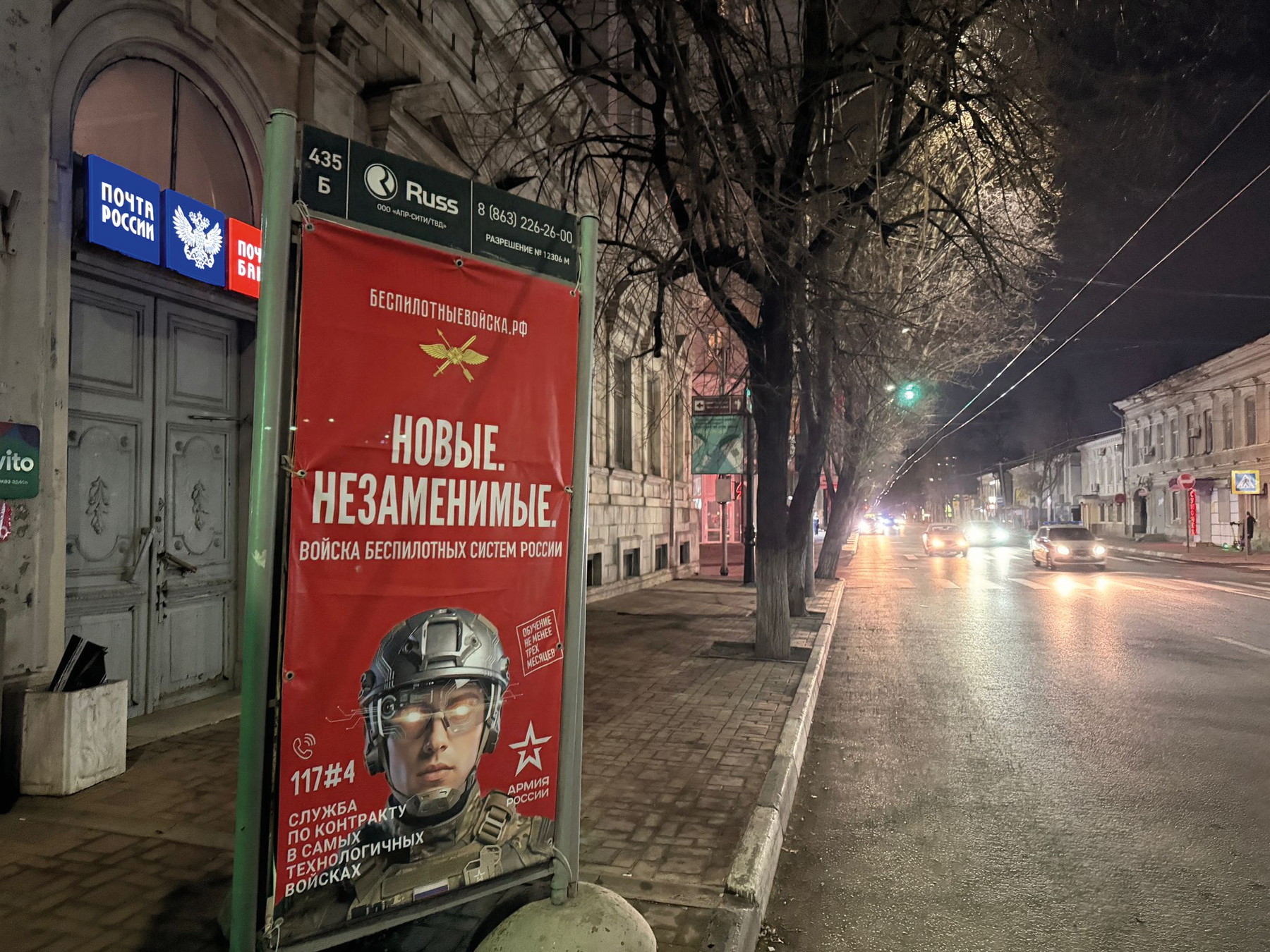
An attractive young cyborg looks out from a red poster. He is wearing a helmet, and his eyes glow behind the lenses of his protective goggles. This is an advertisement for Russia’s Unmanned Systems Troops. “NEW. IRREPLACEABLE.” Below it: “Choose the most technologically advanced troops.” I photographed the poster late one evening in central Rostov.
I have returned here several times since the war began. I saw recruitment advertising in Moscow and St Petersburg too: at metro stations, on buses, on billboards. These advertisements promised good pay and stability, called military service the choice of “real men”, and invited you to join “your own”. A military uniform offered a ready-made image of the person you could become.
The red poster makes a slightly different promise: “Contract service in the most technologically advanced troops.” The young man in the helmet and glowing goggles looked thrilling and intense, like a video game character. The words “technologically advanced” also direct your thinking: you can learn a skill of the future, understand a complex system, master the controls, achieve precision, become a good specialist.
I can understand what is exciting about this possibility. It excites me too. Here is a boyhood dream you can fulfil: a complex but obedient machine moves, sees and acts on your command. There is a screen, coordinates, a target, a mission to complete. Navigation, thermal imaging, controls, an interface, even the signal delay may all be familiar to you from a game.
It offers the pleasure of skill and personal safety, while responsive controls make you feel that you are in command of the situation. The words “the most technologically advanced troops” sustain this fantasy. You can imagine war as an activity in which it is interesting to improve, to become faster and more precise.
On the red poster, a new military dream has been given official form. In the previous one, you had to find the courage to go out and face danger yourself. Here you can think about how well you might handle complex technical work. You can leave no room in this picture for cold, mud, blood, fear, wounds or death. Instead, you can become a precise, technically superior specialist trained in a cutting-edge profession. The question of what you are responsible for can wait until you have learned to operate in this version of the future. Or perhaps, judging by the advertisement, you will never have to think about it at all.
Advanced technology in Russia can be completely ordinary. You use something, and it works. A money transfer to a phone number or a QR-code payment goes through almost instantly. Banking apps have become whole systems of everyday services. On the state portal: passports, taxes, fines, medical appointments, access to school services, benefits, official letters and property documents. Very convenient.
I think that, from the outside, it can be hard to fit this together with everything else. It is easier to imagine Russia as an authoritarian country in decline, with broken streets, primitive bureaucracy and powerless institutions. Yet instant payments and convenient deliveries coexist perfectly well here with censorship, surveillance, repression and war.
A few months after I photographed the red poster, the media began discussing the story of Russian influencers advertising Alabuga Polytech, a technical college in Tatarstan that public reports had linked to drone production. TikTok blocked dozens of accounts, and bloggers swore that they “didn’t understand politics”, “knew nothing” and were “against the war”. Sponsored content included campus tours and lifestyle videos, career advice, memes and jokes. Professionally enthusiastic voiceovers described the world that would open up if you chose the right programme.
After that, the poster seems almost straightforward. At least it said “troops”: the state was recruiting you, and that was visible. With the college, you were invited to think about your future and your career, to choose engineering, programming, robotics or, if manufacturing, then advanced manufacturing, with a profession and a good salary ahead. A drone could first appear in your story as an engineering object you were studying, and only later as a weapon. The language of innovation helps give this a reasonable, ambitious appearance, and all the promises are partly true. You can describe the conditions of study and work quite truthfully without ever explaining to a young person what exactly they are being invited to take part in.
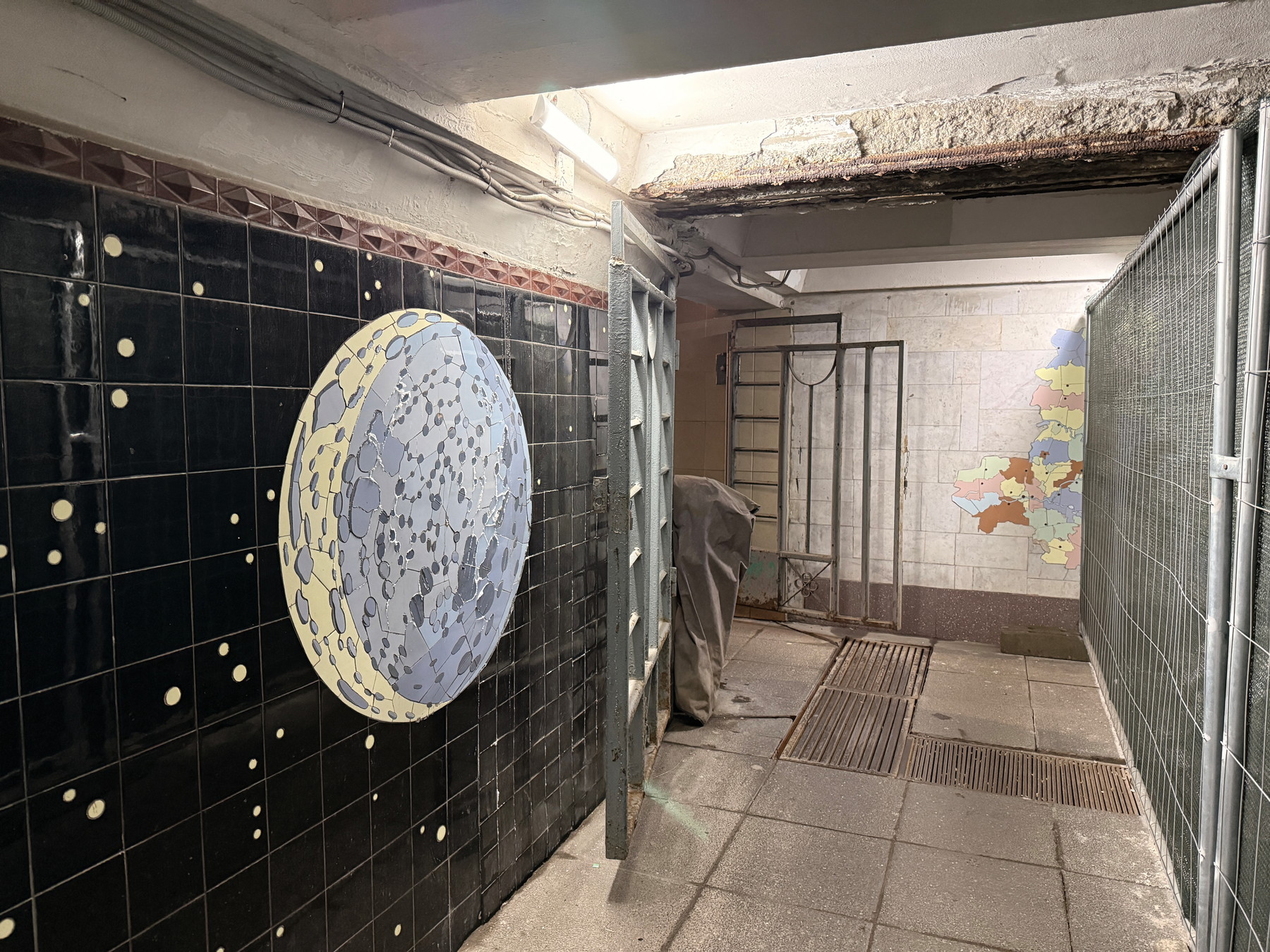
Beside the recruitment poster, I placed a photograph of a Soviet space mosaic that I took the same evening in an underground pedestrian crossing. It also holds a vision of a technological future, and one reason I wanted to put them side by side was the emotional significance technology already had in the Soviet world.
Here is a quotation from the past: in 1963, a group of Soviet cosmonauts wrote to the readers of Technology for Youth:
“From flight to flight, the assignment will become more and more difficult. So each of us, as he goes to the launch pad, deeply believes that his labour [precisely labour!] makes our science and our people more powerful still, and brings closer that wonderful future which all humanity will reach: the communist future.
Yes, to achieve this great goal, we all have a great deal to do. That is what being young is for: building the future.”
“Precisely labour!” Behind the space flights were people’s work and their belief in a communist future. To become part of this future, you needed knowledge and skills. A young reader dreamed of becoming a physicist or an engineer, of studying mathematics. Even learning how to make a complex part in a factory meant a chance to have a hand in building a wonderful future. In 1963, this seemed especially real: Sputnik had recently reached orbit, and Gagarin really had been to space. What could previously only be imagined had become possible. If it was possible to send a person into space, you could expect great changes in life on Earth too. Science gave the country reasons to be proud of itself.
Military objectives were closely connected with these achievements. The R-7 rocket, which put the first satellite into orbit, was developed as an intercontinental ballistic missile. Space exploration drew on developments for delivering nuclear weapons. An engineer’s interest in a difficult problem, their professional pride and the state’s purpose for their work could coexist. Beside today’s poster, the mosaic also reminds me of that closeness. The question of what you knew how to create was already connected to the question of what it would be used for.
In the advertisements for the Unmanned Systems Troops and the technical college’s videos, I recognise an appeal to the desire to master something difficult and find your place in it. I understand why young people might want to be among specialists who can do things that seemed impossible only recently. Along with the profession, though, you have already been offered a war in which you will have to take part.
Sources and further reading
- Student recruitment for Russia’s drone regimentsLe Monde, English edition, 26 July 2026
- Military recruitment, university students and gamingCNN report, republished by KESQ, 14 April 2026
- Fast payments by phone number and QR codeBank of Russia, Faster Payments System, English version
- Digital public services in RussiaWorld Bank, Russia Digital Economy Report, 2018
- Internet censorship, control and surveillance in RussiaHuman Rights Watch, Disrupted, Throttled, and Blocked, 30 July 2025
- Alabuga Polytech and UAV productionU.S. Department of the Treasury, sanctions announcement, 23 February 2024
- English-language record of 2026 reporting on the Alabuga advertising campaignAlabuga Evidence Archive, media record for CBS News coverage
- Social-media recruitment and work at AlabugaAssociated Press, investigation into recruitment for Russian drone production
- Soviet space culture and visions of the futureScience Museum, Cosmonauts: Birth of the Space Age
- Letter from a group of cosmonauts to the magazine’s editorsTekhnika — Molodyozhi (Technology for Youth), 1963, no. 7, p. 1. Russian original.
- Sputnik and the beginning of the space ageNASA, 65 Years Ago: Sputnik Ushers in the Space Age
- Yuri Gagarin’s first human spaceflightNASA, Yuri Gagarin: First Human in Space
- The R-7 missile and the launch of SputnikNASA History, Korolev — Sputnik, James Harford