Bird Market
I had just started school when my parents went into business. A lot of people were going into business then. Russia’s borders had opened, and people were rushing to the West to buy things, bring them back and sell them. If you could go abroad, bring something back and try to sell it, you did. There was so much hope, so much people wanted to do.
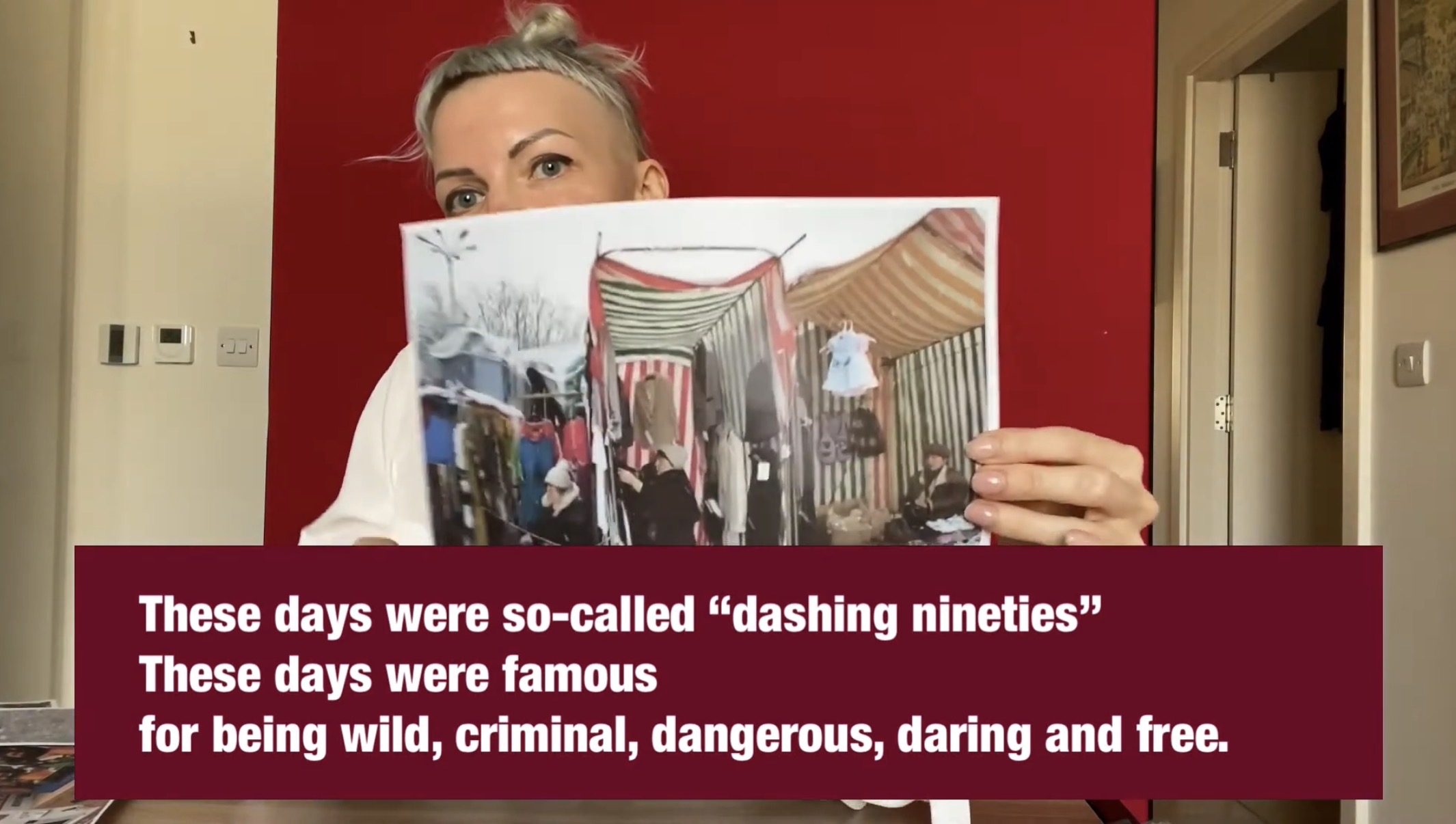
We lived right next to a market in Rostov-on-Don, one of the places where this new capitalism was taking shape. I remember it as the Bird Market. The name was left over from Soviet times. I think they sold poultry and small animals there. I don’t know for sure. In the early 1990s it grew into the Kolkhozny Market. It was enormous, pretty haphazard and pretty wild, and it spread into all the surrounding streets.
Video still
London, 2022
There was everything you could imagine there. Animals too, unfortunately. The bit of the market for animals was small. But the market itself was gigantic. For us children, it was an amazing world. We understood very little of what was going on. Well, not just children. Looking back, I don’t think the adults understood much about the ethics of treating animals either.
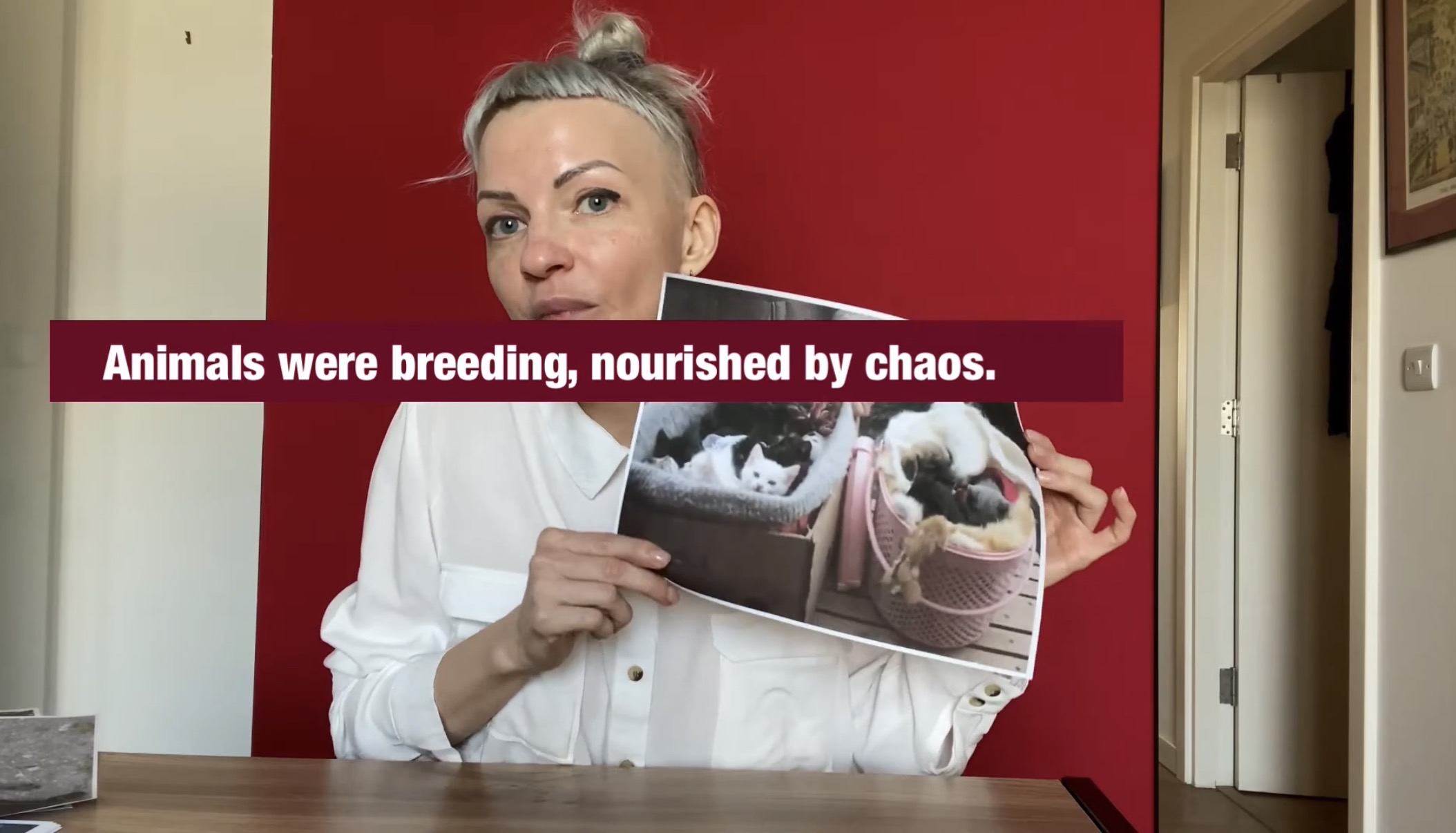
People trying to give away kittens and puppies stood out in the streets among the traders. I don’t remember anyone talking about neutering cats and dogs or controlling their breeding. The animals bred as they pleased, and it did them no good at all.
My grandmother, for example, had two cats when my father and his sister were growing up. She told me she regularly drowned their kittens. It was just maintenance: if you had a female cat, you had to accept this necessity. Otherwise, why get yourself a “woman-cat”? Having her neutered didn’t enter into it. What else were you supposed to do with the kittens?
Looking back, I can see that my grandmother was pretty brutal. My father drowned kittens too. I didn’t know this while I was growing up; I found out later. He did it quietly.
I’ll let you in on a secret: there are still plenty of stray animals in Russia. Of course, it isn’t like the 1990s now. Back then it was a complete fucking mess. Packs of stray dogs. It was dangerous, grim and frightening.
Video still
London, 2022
But not everyone was as brutal as my grandmother. There were also the kind-hearted people who came to the market to give animals away. I assumed they had cats of their own and weren’t considering neutering either. Of course, I don’t know what those people had in mind. Maybe they were just giving away animals they’d found somewhere, animals somebody else had abandoned.
Almost every week, somebody left kittens or puppies in our courtyard. My guess was that at least some had been left by people who’d tried to give them away at the market and failed. If it was them, I suppose they weren’t quite heartless, but they weren’t very far from it.
I was a child, and I really did love animals. I read Gerald Durrell, James Herriot and Joy Adamson. My friend Diana and I regularly bought books from the Green Series, which included writers like Dian Fossey, writing about gorillas. These books, and the people who made zoology accessible and encouraged a love of animals, were a big part of my life.
But loving animals is one thing. Thinking about the ethics of how we treat them is another. In my second year studying Fine Art at university, I chose to work on posthumanism, probably because of this childhood dilemma. I’m not sure I recognised it as a dilemma then. But I was seeing the harsh reality of what happened to the kittens that hadn’t been drowned.
I should give reality its due: some kittens did survive. Some people would say that life in the wild works in the same way: animals have young, and some die in terrible accidents or are eaten by their own kind. We saw these things as children. For cats living outside, the world can be brutal. And yet kittens are so small and so cute. They make you feel so much.
This still matters to me. Perhaps I’ll return to it one day.
Video still
London, 2022
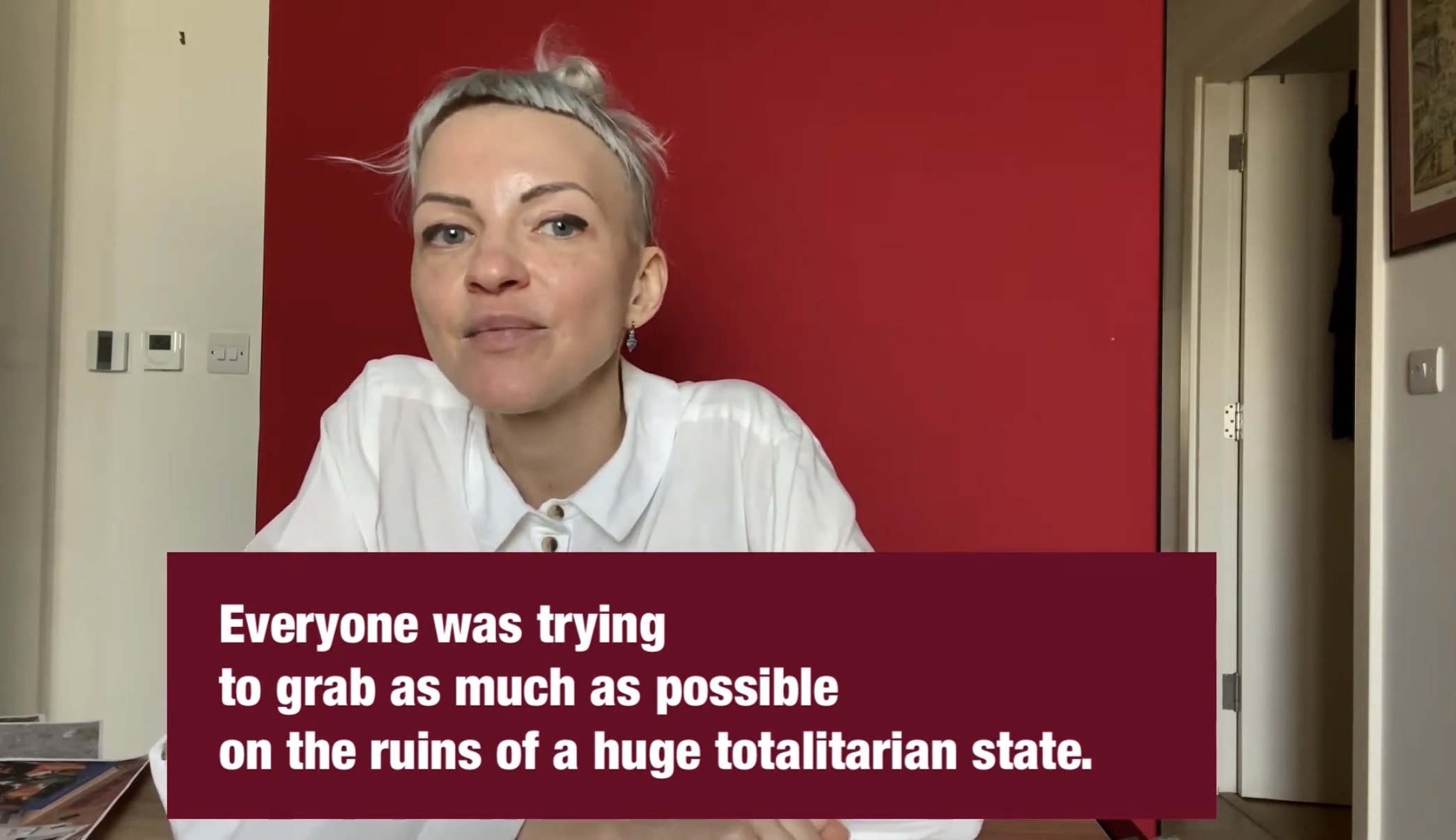
Bird Market began as a video for the Place project on my CSM Foundation course in 2022. I sat at a table, talked about my childhood and showed photographs. I thought the work was rather simple. I deliberately destroyed the video. What remains is a record of what I said and a few stills. I wrote this essay in 2026.