The Force of Good
Photography / text / public language
Rostov-on-Don, 2026
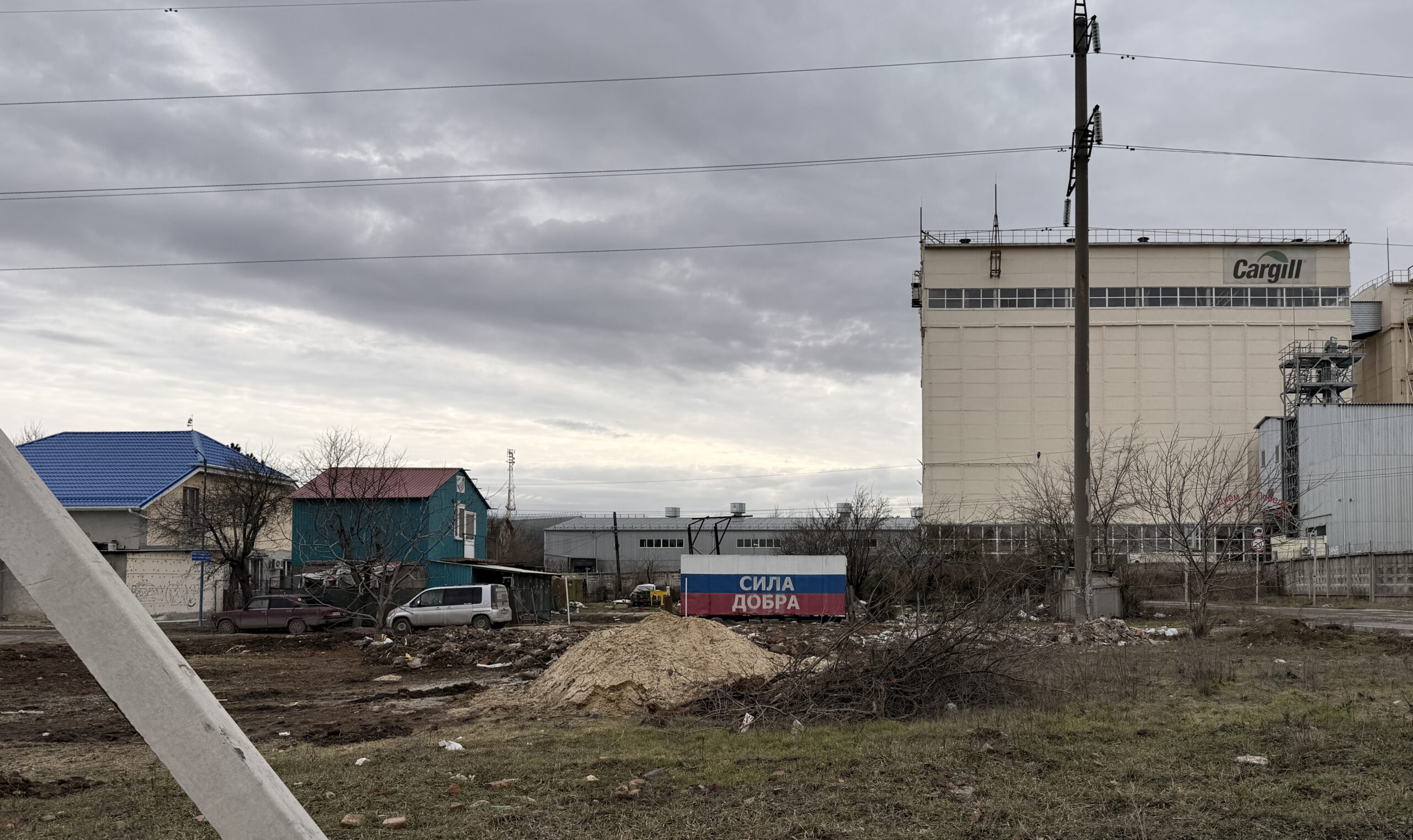
I made this photograph on the road to the dacha settlements outside Rostov-on-Don. A low structure painted in the colours of the Russian flag carried the words “СИЛА ДОБРА” — “The Force of Good.” I asked the car to stop.
Russia was at war. We were beside an industrial site, and my companions warned me that photographing it from a car might be mistaken for intelligence gathering. I took the picture and we drove on.
Digital photograph
The roadside
Later, looking at the photograph, I noticed the name Cargill on the large building behind the painted structure. The frame holds two declarations of good: a patriotic moral slogan in the foreground; behind it, a global company whose public vocabulary includes feeding, supply, productivity and development.
The photograph contains a large amount of open ground. Houses, road, wires and industrial buildings are separated by distance. The space is wide; nothing in it suggests care for walking, pausing or remaining there.
The words
Сила can mean power or force. Power sounds reassuring. Force keeps the possibility of pressure, coercion and armed force. Добро is larger than доброта, kindness. It names Good as a moral side: something that can be defended, organised and fought for.
Painted in the colours of the Russian flag during Russia’s invasion of Ukraine, the phrase makes a public claim about who represents Good and how that Good may act.
The diptych
In No Direct Route, this photograph appears beside Human Anthill.
Human Anthill shows a street compressed by traffic, signs, wires and an advertisement asking, “Tired of living in a human anthill?” Its answer is a new development of “only eight floors.” The Force of Good releases that density into open ground. The wider space offers no corresponding sense of care.
Together, the photographs ask what makes a place liveable. The pair moves between urban compression and open space arranged without tenderness.